How a Trade-In Lowers Your Florida Sales Tax
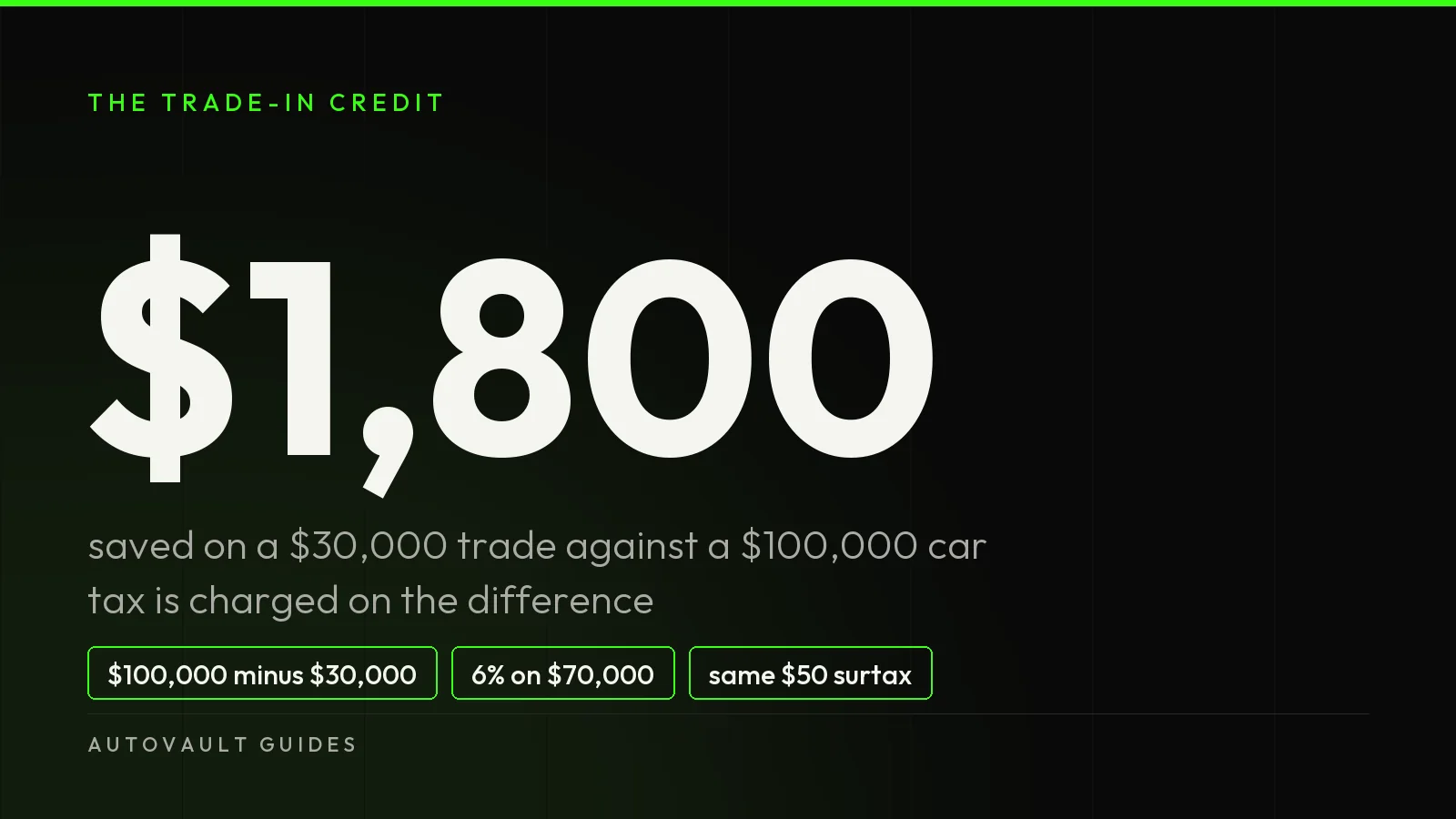
When you trade a car in as part of the same deal, Florida charges sales tax on the price of the car you buy less the trade-in allowance, not on the full price. On a $100,000 car with a $30,000 trade, the taxable amount is $70,000 and the state tax falls from $6,000 to $4,200. The trade has to be written into the same transaction, and it does not have to be titled in your name.
The rule, in one line
Florida Statutes s. 212.09 says that where a used article is taken in trade as a credit or part payment on the sale of another article, the tax is paid on the sales price less the credit for the article taken in trade. The Department of Revenue puts the same rule in its motor vehicle brochure, GT-800030: a registered motor vehicle dealer may deduct a trade-in allowance from the taxable sales price of a motor vehicle when, in a single transaction, the trade is part of the motor vehicle sale.
That is the whole rule. The allowance comes off the price before the 6 percent state tax is worked out, and the county surtax is worked out on the same reduced figure. This article is one part of our guide to Florida tax, tag and title for exotic cars, which covers the rest of the out the door figure.
Two things follow. The trade has to be part of the same transaction, and the tax is worked out on the allowance the dealer gives you, not on what you owe on the car or what you paid for it.
The worked example: a $30,000 trade on a $100,000 car
Take a $100,000 car bought by a Miami-Dade resident who has a Florida plate to move over. With no trade, the state tax is 6 percent of $100,000, which is $6,000. The Miami-Dade surtax is 1 percent of the first $5,000, which is $50, at the 2026 rate on Form DR-15DSS. Tax and the $695 title, tag and docs line together come to $6,745.
Now put a $30,000 trade into the same deal. The taxable amount is $100,000 less $30,000, which is $70,000. The state tax is 6 percent of $70,000, which is $4,200. The surtax is still $50, because s. 212.054 stops the surtax at the first $5,000 and both $100,000 and $70,000 are above that line. Tax and fees come to $4,945.
| Line | No trade-in | $30,000 trade-in |
|---|---|---|
| Price of the car | $100,000.00 | $100,000.00 |
| Trade-in allowance | $0.00 | $30,000.00 |
| Taxable amount | $100,000.00 | $70,000.00 |
| State sales tax, 6% | $6,000.00 | $4,200.00 |
| Miami-Dade surtax, 1% of the first $5,000 | $50.00 | $50.00 |
| Title, tag and docs | $695.00 | $695.00 |
| Tax and fees | $6,745.00 | $4,945.00 |
The trade saves $1,800 in tax, on top of the $30,000 that comes off what you pay for the car. The $695 title, tag and docs line is not taxed and is the same with or without a trade. Put your own figures into the trade-in field of the Florida tax, tag and title calculator and it does this arithmetic for your county.
The surtax is the one line a trade rarely moves. On any car priced above $5,000 it is a flat figure, $50 at 1 percent, $75 at 1.5 percent, $25 at 0.5 percent and nothing in Collier, so a trade only lowers it when the taxable amount drops under $5,000. Our article on the Florida county surtax covers the rest.
The allowance and the payoff are different numbers
Most cars that come to us in trade have a loan on them. That does not change the tax. The credit is the trade-in allowance, the figure agreed for your car and written on the contract. FLHSMV's procedure for tax collectors, Procedure TL-08, says tax is collected on the difference between the trade-in allowance of the item being traded and the sale price of the vehicle being purchased. It says nothing about what is owed on the trade.
The payoff is a separate matter between the dealer and your lender. FLHSMV's Selling a Vehicle page says a consumer can trade in a vehicle with an existing lien at a dealership, and that the dealer then has 10 days to satisfy the lien before selling the car to another customer. The lender stays on the title until the lien is paid in full and the lender has filed a lien satisfaction with FLHSMV.
So the figures do different jobs. The allowance sets the tax. The payoff settles the old loan out of the allowance, and what is left goes toward the new car. If the payoff is larger than the allowance, the difference is a debt you still owe, and settling it is a financing conversation, not a tax one. The tax credit is the same either way.
One transaction, and not always your name
The credit only exists inside one transaction. Florida's administrative rule on trade-ins, Rule 12A-1.074, says a separate or independent sale is not a trade-in, even if the proceeds are immediately applied to a purchase. Sell us your car on Monday and buy on Wednesday and Florida sees two deals, with tax on the full price of the second. Tell us at the start that the car is a trade, and it goes on the same contract as the car you are buying.
The trade does not have to be in your name. Procedure TL-08 says the trade-in vehicle may be provided by a third party other than the purchaser, and does not have to be titled in the name of the purchaser, as long as the trade-in and the purchase are part of a single transaction. The conditions are that the owner assigns the title directly to the dealer making the sale, and that the car is identified on the sales contract as the trade-in. A car in your spouse's name or your company's name can be the trade on a car you buy in yours.
A leased car is different. The same procedure says no allowance is given for a leased vehicle traded in by the lessee, because the lessee is not the owner. If you are coming out of a lease, the leasing company owns the car, and handing it back is not a trade for tax purposes. Ask us before you count on a credit for a leased car.
It lowers the amount financed as well
The allowance does a second job on a financed purchase. It comes off the amount you borrow, the same way a down payment does, so the trade lowers the tax and the loan at the same time. The exotic car payment calculator has a trade-in field and shows what the allowance does to the amount financed, using the APR your own lender has quoted you. We print no rate and no payment here, because the rate belongs to the lender.
AutoVault is not a lender. Financing is arranged through third-party lenders and is subject to credit approval.
What the trade needs
The paperwork for a trade is the paperwork for any Florida title transfer, and most of it is ours to do. Every item below comes from FLHSMV's own pages on liens and titles and on selling a vehicle.
- The title. Paper or electronic. FLHSMV says it is not necessary to request a paper title before trading a vehicle with a licensed Florida dealer, so an electronic title is fine as it is. If a paper title has been lost, a duplicate is applied for on form HSMV 82101 before the car can change hands.
- The odometer reading. Florida titles carry a space for the odometer disclosure, and both buyer and seller must acknowledge it on a title transaction. The reading at the time of the trade goes on the title paperwork.
- The lien. If there is a loan on the car, a payoff letter from your lender, so the lien can be satisfied. FLHSMV allows a car with an existing lien to be traded at a dealership and gives the dealer 10 days to satisfy it. The lender stays on the title until it is paid and a lien satisfaction is filed.
- A VIN inspection, if the car was never titled in Florida. A car on an out-of-state title needs a Vehicle Identification Number and Odometer Verification, form HSMV 82042, which a licensed Florida dealer can complete.
- Your plate. In Florida the plate stays with the seller, not the car. Take it off the trade and it moves to the car you are buying, which is what keeps the $225.00 initial registration fee, the figure on HSMV 83140, off the deal.
- The owner, if it is not you. On a third-party trade the owner signs the title over to the dealer directly, and the car is named on the contract as the trade-in.
Bring those and the trade is written into the contract, the tax is worked out on the reduced figure, and the title work goes through with the rest of the deal.
If you live in another state
Florida applies the allowance to an out-of-state buyer as well. The Department of Revenue's TIP 26A01-01 works its examples for a nonresident with a $17,000 trade-in allowance taken off a $50,000 price before the home state rate is applied, so the credit is built into the partial exemption, not left out of it.
What your home state does is a separate question. When you register the car at home, your state charges its own tax under its own rules, and Florida's chart says plainly that it must not be used to work out what another state will charge. Some states give no trade-in credit at all. Virginia, for one, defines the taxable sale price in Code of Virginia s. 58.1-2401 as the total price without any allowance or deduction for trade-ins. Three states, Arkansas, Mississippi and West Virginia, give no credit for the tax you paid Florida, so a buyer from those states pays twice whatever the trade. Ask your home state's tax authority before you count on the saving. Our article on buying a car in Florida from another state covers the DR-123, the 45 day rule and the rest.
Work out your own number
Put the price of the car and your trade-in allowance into the Florida tax, tag and title calculator and pick your county. It shows the taxable amount, the state tax, the surtax and the $695 title, tag and docs line, with and without the trade. If you are financing, the payment calculator takes the same allowance off the amount financed.
Then pick the car. Tell us about the trade when you ask about anything in our inventory, and we put the allowance, the tax and the out the door figure in writing before you sign.
A trade is the one place the state gives you money back. A $30,000 trade against a $100,000 car saves $1,800 in tax before we talk about the price, so bring the payoff letter and the title and let me run both numbers.
AutoVault
Frequently asked
Where the figures on this page come from
- Florida Statutes s. 212.09, Trade-ins deducted; exception, 2026 Florida Statutes
- Sales and Use Tax on Motor Vehicles, GT-800030, Florida Department of Revenue, R. 08/22
- Rule 12A-1.074, Florida Administrative Code, Trade-Ins, amended 7-20-11
- Division of Motorist Services Procedure TL-08, Sales and Use Tax, Transfer of Motor Vehicles, Mobile Homes, and Vessels, FLHSMV, Rev. 07/26
- Selling a Vehicle, FLHSMV consumer education page, read 2026-09-20
- Liens and Titles, FLHSMV, read 2026-09-20
- Florida Statutes s. 212.054, Discretionary sales surtax, 2026 Florida Statutes
- Discretionary Sales Surtax Information for Calendar Year 2026, Form DR-15DSS, Florida Department of Revenue, R. 11/25
- TIP 26A01-01, Motor Vehicle Sales Tax Rates by State, Florida Department of Revenue, issued 11 February 2026
- License Plate Rate Chart, HSMV 83140, FLHSMV, Rev. 08/26
- Code of Virginia s. 58.1-2401, Definitions, sale price, amended 2023