Florida Tax, Tag and Title on an Exotic Car
A car you register in Florida carries 6 percent state sales tax on the price after any trade-in, a county surtax that stops at the first $5,000, one $695 title, tag and docs line, and the state's $225.00 initial registration fee, charged only to a buyer with no Florida plate to bring to the car. On a $100,000 car registered in Miami-Dade that comes to $106,745.00 with a plate to transfer, or $106,970.00 without one. A resident of another state who signs Form DR-123 at the sale pays their home state rate instead, capped at 6 percent, with no surtax.
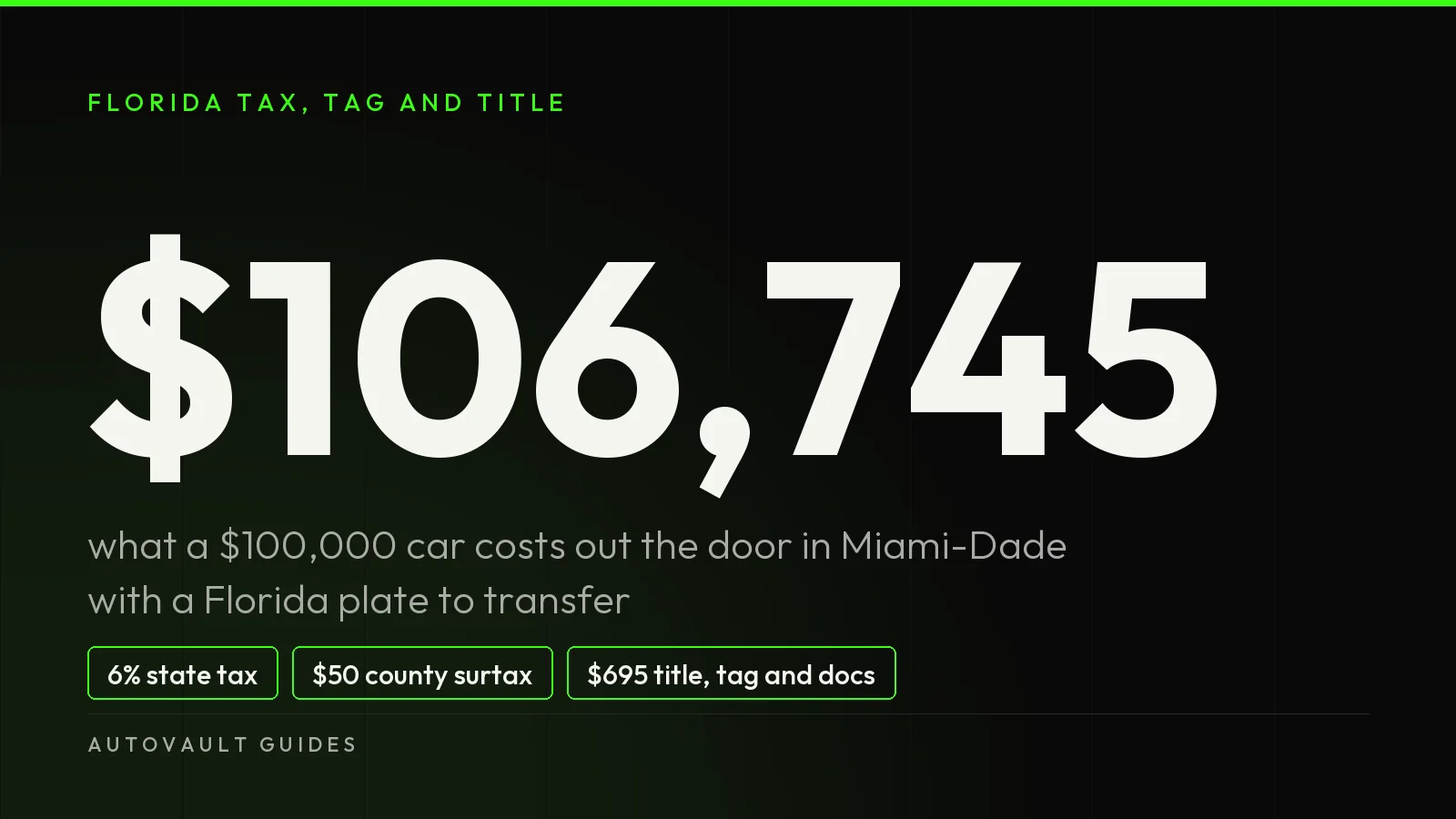
What you pay, in four lines
Every car you buy from us and register in Florida carries the same four lines above the price: the 6 percent state sales tax, a county surtax that stops at the first $5,000, one $695 line for title, tag and docs, and, only when you need a new plate, the state's $225.00 initial registration fee. Nothing else of ours goes on the sheet. This guide walks through each line, says where the figure comes from, and shows what changes when you live in another state, trade a car in, or ship the car out of Florida.
If you want the number before the reasons, the Florida tax, tag and title calculator works it out for any price, any county and any home state, with every line shown on its own. This page is the long version of what that calculator does.
Three shorter guides sit under it: the county surtax explained, buying a car in Florida from another state and the trade-in sales tax credit. Every rate and fee here comes from a Florida Department of Revenue or FLHSMV document, named with its revision date in the sources at the end. Rates were last checked on 19 September 2026. This is an estimate, not tax advice.
The 6 percent state tax
The state rate is 6 percent, and it is charged on the sales price of the car after any trade-in allowance taken in the same transaction. On a $100,000 car with no trade the state tax is $6,000.00. On a $250,000 car it is $15,000.00. New or used, a Honda or a Rolls-Royce, the rate is the same, and there is no luxury bracket above it and no ceiling on it.
Florida works the tax out to the third decimal place. When that third decimal is above 4, the tax rounds up to the next cent. On a round price you never see it. On a price of $87,455.75 the raw tax is $5,247.345, and the 5 in the third place carries it to $5,247.35. That rule is why our sheet and a home spreadsheet can differ by a cent.
The fees sit outside the tax. Florida's base is the price after the trade-in, and a charge that state law sets for a title, a plate, a registration or a lien is not part of that base. The $695 line and the $225.00 fee are therefore added after the tax is worked out, and neither one is taxed.
The county surtax stops at $5,000
On top of the state tax, the county you register in may charge a discretionary sales surtax. Two rules make it far smaller than most buyers expect.
The first is the cap. Under s. 212.054 the surtax reaches only the first $5,000 of the taxable amount, and everything above that line is free of it. On any car worth more than $5,000 the county line is therefore a fixed sum: $25 in a half percent county, $50 at 1 percent, $75 at 1.5 percent, and nothing in Collier, the one county on our list with no surtax. A $60,000 car and a $600,000 car carry exactly the same county tax.
The second is whose county counts. The same section deems the sale to have taken place in the county of the buyer's residence address on the registration or title, and the dealer's county is irrelevant. We are in Miami-Dade. A buyer who registers at a Palm Beach address pays the Palm Beach rate, and a buyer who registers in Collier pays no surtax at all, though the car was bought in North Miami and driven away from there.
Rates move, and Palm Beach is this year's proof. The county's 1 percent infrastructure levy was repealed at the close of 2025 and a half percent school levy took its place on 1 January 2026, which halves the surtax on a car registered there from $50 to $25. A calculator nobody has updated since December still shows $50. Every county figure in this guide is the 2026 rate from Form DR-15DSS, R. 11/25, which the Department of Revenue reissues each November.
The longer version is in the county surtax explained.
By county
All 67 counties are in the calculator's dropdown. The ten below each have a page of the calculator of their own with the county's 2026 rate already set. Across all ten the state tax and the $695 line do not change. The surtax line is the only one that does.
- Miami-Dade County, one percent, our own county
- Broward County, one percent
- Palm Beach County, half a percent
- Monroe County, one and a half percent
- Collier County, no surtax
- Lee County, half a percent
- Orange County, half a percent
- Hillsborough County, one and a half percent
- Pinellas County, one percent
- Duval County, one and a half percent
Most buyers who drive to us register in one of the first two. A North Miami, Aventura, Sunny Isles Beach or Miami Beach address is Miami-Dade, and so is Coral Gables or Brickell, and the Miami-Dade County calculator is set to its 1 percent rate. Hallandale Beach and Fort Lauderdale are across the county line in Broward, also 1 percent in 2026, and the Broward County calculator runs that case. In either county the surtax on any car above $5,000 is $50.
What a trade-in does to the tax
Take a car in trade as part payment, in the same transaction, and the allowance comes off the price before the tax is worked out. That is real money, not a paper discount. Put a $30,000 allowance against a $100,000 car and the state taxes $70,000: $4,200.00 instead of $6,000.00, which leaves $1,800.00 with you. A $150,000 trade against a $400,000 car keeps $9,000.00 of state tax out of the deal.
The car you trade need not be titled to you. What the rule requires is that the trade and the purchase are one transaction on one contract. A car sold separately, with the cash then put toward the purchase, is two transactions in Florida's eyes, and the credit belongs to a trade, not to cash.
The surtax base drops too, but on an exotic car you will rarely notice, because the taxable amount before and after the trade is usually still above the $5,000 cap. In the example above, the Miami-Dade surtax stays at $50 either way.
A buyer from another state should read the next section before counting on this. Some states allow no trade-in credit at all, and Florida's chart of state rates is not a model of each state's rule. The full treatment is in the trade-in sales tax credit in Florida.
If you live in another state: Form DR-123
A large share of our buyers register their car somewhere else. Florida wrote a partial exemption for exactly that buyer, in s. 212.08(10), and every condition of it is met or missed at the sale.
Here is the rule in one sentence. A resident of another state who takes delivery in Florida pays Florida what their own state would have taxed on the same sale, and never more than Florida's 6 percent. Two things make it happen: you sign Form DR-123, a notarized affidavit, at the time of sale, and you register the car at home within 45 days. There is no requirement that the car leave the state in those 45 days, so a car bought here and left in storage here is fine. Because there is no Florida registration, there is no county surtax and no $225.00 initial registration fee. The $695 title, tag and docs line is on every purchase here, wherever the car is registered.
Miss the form and the exemption is gone. It cannot be signed afterwards, and without it Florida collects its full rate. The cap works the other way too: a buyer from a state at or above 6 percent, Texas at 6.25 percent or California at 7.25 percent, pays the full 6 percent here and settles any difference at home.
The Department of Revenue publishes each state's rate every year in a Tax Information Publication, now TIP 26A01-01, and three groups on that chart change the answer.
States with no tax on a car
Twelve states and the District of Columbia are listed as None. Oregon, Montana, New Hampshire, Georgia and North Carolina are among them, and a buyer from any of them signs the DR-123 and pays Florida nothing. Their own state still collects at registration, a highway use tax in North Carolina and a title tax in Georgia among them. The full list is in buying a car in Florida from another state.
States that give no credit
Arkansas, Mississippi and West Virginia collect their own tax in full when you register and do not credit what Florida collected. A buyer from one of those three can pay twice, and should ask their own tax office before taking delivery here, because the export route below may be the better one.
Caps and tiers
South Carolina's tax stops at $500, so $500 is what Florida collects from a South Carolina buyer on a $100,000 car and on a $400,000 one. Connecticut charges 6.35 percent on the first $50,000 and 7.75 percent above it, both over Florida's cap, so Florida collects 6 percent. Virginia is 4.15 percent with a $75 floor and gives no trade-in credit. The chart carries no local rate, and the Department says it is not to be used to work out what another state will charge when you register there.
The rest of what an out of state buyer needs, from the temporary tag to the drive home, is in buying a car in Florida from another state.
Export: when no Florida tax is due at all
The DR-123 lowers the tax. The export rule removes it. GT-800030 lists two deliveries that carry no Florida sales tax at all: we deliver the car to you outside Florida, or we hand it to a common carrier, a licensed exporter or a freight forwarder that ships it out of the state. There is no DR-123 on such a sale, because there is nothing to reduce. The whole question is who moves the car. Section 212.06(5) presumes that a buyer who is at the sale in person took delivery here, and a transporter you booked yourself is not a common carrier we delivered to. If the car is going out on a truck, say so before the contract is drawn up, because the tax line is fixed at the sale.
The reduction in the section above is for residents of another state, and the statute means a state of the United States. A buyer who lives in another country, or in a United States territory, and who takes the car here pays the full 6 percent, because there is no home state rate for Florida to match. For that buyer the only route to zero is the export route: the car leaves Florida by carrier or by our delivery, never with the buyer at the wheel.
Title, plate and registration: what the state charges
Every title and registration charge the state makes is public. FLHSMV prints the title fees in its schedule fees-01 and the plate and registration fees in the rate chart HSMV 83140, and the tag and title table on the calculator page sets them out line by line with the source of each figure. This guide does not repeat that table. What matters here is how those figures reach you, and why you never pay them one at a time.
On a purchase from us you see one $695 line for title, tag and docs. It covers the state's title and tag work and the documents we prepare and file. The one state charge that stands on its own is the $225.00 initial registration fee, and it appears only when no Florida plate of yours is moving to the car.
Three things about the state's figures are worth knowing even so. Registration is charged by the car's net weight in three bands, and the top band, 3,500 lbs and up, is where most exotic and luxury cars land. The registration figure is a base tax with a fixed set of add-on fees stacked on it, which is why the published amounts are not round numbers. And registration is not prorated. Whatever month of the period you register in, the full year is charged.
None of it is taxed, and neither is the $695 line, for the reason given under the state tax above.
The $695 title, tag and docs line
On every purchase here, in Florida or out of state, one line covers the paperwork: $695 for title, tag and docs. It pays for the state title and tag work and the documents we prepare and file for you. It is the only fee we charge. It is the same figure in every county and for every buyer, and it is not taxed.
The one thing that changes beside it is the state's $225.00 initial registration fee. Florida charges it once, when a plate is first issued to you, and it appears only when you have no Florida plate to move over. It is a state charge, not ours, and it is not taxed either. With a plate to transfer, the fee side of the deal is $695.00. Without one, it is $920.00.
Our terms say the same in one sentence: an advertised price leaves out tax, title, registration and paperwork, and the final figure is put in writing at the time of purchase. Read them at Terms and Conditions before you sign anything.
If you already hold a Florida plate
A plate you already hold is worth $225.00 on the day you buy. Section 320.0609 treats the transfer of your own plate to a car you have just acquired as something other than a new registration, and the initial registration fee is charged only on a new one, so bringing the plate takes the line off the sheet. A second rule in the same section matters when the new car is heavier than the old: as long as the old car and the new one both sit in the ordinary private car and light truck classes, the state asks for no further registration tax until the current period runs out, so a buyer moving up from a sedan to an SUV pays nothing extra for the weight until renewal.
The state's own charge for the transfer is $4.10 on the rate chart, and a tax collector's office can add a $0.50 service fee. On a purchase here the $695 line is the same figure whether a plate moves or not. The renewal date does not reset either. The plate keeps the expiry it had, so a plate due in March is still due in March.
When you trade in or sell the old car, the plate comes off it. Florida has you either move it to the replacement or turn it in, so a buyer replacing one car with another should bring the plate to the sale.
A worked example: a $100,000 car in Miami-Dade
Take a Miami-Dade resident buying a $100,000 car with no trade-in and a plate to bring along. It is the case the calculator opens on, and the Miami-Dade County page has it set up already.
| Line | Amount |
|---|---|
| Price after trade-in | $100,000.00 |
| State tax at 6 percent | $6,000.00 |
| County surtax, Miami-Dade, on the first $5,000 | $50.00 |
| Title, tag and docs | $695.00 |
| Initial registration, plate moved over | $0.00 |
| Out the door | $106,745.00 |
Tax and fees come to $6,745.00 on a $100,000 purchase. Change one thing at a time and you see what each rule is worth.
- No plate to transfer: add the $225.00 initial registration fee and the total is $106,970.00.
- Register in Broward instead: the same $106,745.00, because Broward is also 1 percent. The Broward County page runs it.
- Register in Palm Beach: the surtax drops to $25.00 and the total is $106,720.00.
- Register in Collier: no surtax, so $106,695.00.
- Trade in a $30,000 car: the state tax falls to $4,200.00, the surtax stays at $50.00, and the total is $104,945.00.
- New York resident with a DR-123 signed at the sale: Florida collects 4 percent, $4,000.00, no surtax, and the total is $104,695.00.
- South Carolina resident with a DR-123: $500.00 of tax, and $101,195.00 out the door.
- Texas resident with a DR-123: Texas is 6.25 percent, so Florida collects the 6 percent cap, $6,000.00, and the total is $106,695.00.
The pattern is worth seeing once. On a car at this price the county surtax is worth $25 to $75, the plate transfer is worth $225.00, the DR-123 is worth $2,050.00 to a New York buyer, and the trade-in credit is worth 6 percent of whatever you trade. The first two are small money. The last two are not.
Small charges that can still appear
A few figures sit outside the four lines and appear only when your paperwork calls for them.
- A lien. If a lender's name goes on the title, the state records the lien at $2.00.
- A paper title. Florida holds titles electronically. A paper certificate mailed to you is $2.50.
- A county service fee. A tax collector's office may add $0.50 to a transaction.
- A late title application. A title application filed 30 days or more after the sale carries a $20.00 penalty. On a purchase here we file the paperwork, which is what the $695 line is for.
- A temporary tag. An out of state buyer who drives the car home gets a Florida temporary tag. The tag agency's charge for it varies and is not in the totals above.
- Your home state. If you register the car outside Florida, your own state's tax, local taxes and registration fees come on top of everything here, and they are not worked out on this site.
What this guide does not do
A few limits, stated once. Everything on this page is arithmetic on rates the state publishes, and the tax collector and your signed purchase agreement decide the final figure, so read it as an estimate and not as advice. Nothing here works out what your own state will charge when you register at home, and Florida's chart of state rates carries no local tax at all. The trade-in credit is applied to every buyer in the examples above, but a state that gives no credit, or gives it only on a new car, will not pass it through, so a nonresident with a trade should read the article on buying from another state first. The $225.00 initial registration fee belongs to the private car and light truck classes, which is where an exotic, a luxury sedan or an SUV sits; a heavy pickup registered by gross weight is a different case. And the rates move: the surtax form is reissued each November and the notice of state rates each January or February, so look at the date on the calculator before you rely on a figure.
Run your own number
The Florida tax, tag and title calculator takes a price, a trade-in, a county or a home state, and a plate, and gives you the out the door figure with every line shown on its own. The county pages above do the same with the county already set. When you are ready to put a real car in it, the inventory lists every car we have with its price, and the out the door figure goes in writing before you sign.
If you are financing, the exotic car payment calculator works out the monthly side. AutoVault is not a lender. Financing is arranged through third-party lenders and is subject to credit approval.
Buyers ask me what the car costs to drive home before they ask anything else. On a $100,000 car in Miami-Dade the answer is $6,050 in tax and $695 for title, tag and docs, and I would rather you see that number here than hear it at signing.
AutoVault
Frequently asked
Where the figures on this page come from
- Sales and Use Tax on Motor Vehicles, GT-800030, Florida Department of Revenue, R. 08/22
- Discretionary Sales Surtax Information for Calendar Year 2026, Form DR-15DSS, Florida Department of Revenue, R. 11/25
- TIP 26A01-01, Motor Vehicle Sales Tax Rates by State, Florida Department of Revenue, issued 11 February 2026
- Form DR-123, Affidavit for Partial Exemption of Motor Vehicle Sold to a Resident of Another State, Florida Department of Revenue, R. 01/21
- Schedule of Motor Vehicle Title and Lien Fees, fees-01, FLHSMV, Rev. 04/26
- License Plate Rate Chart, HSMV 83140, FLHSMV, Rev. 08/26
- Motor Vehicle and Mobile Home Class Code and Fee Chart, fees-03, FLHSMV, Rev. 09/26
- Sales and Use Tax, Florida Department of Revenue, the 6 percent rate and the third-decimal rounding rule, read 2026-09-19
- Florida Statutes s. 212.054, the $5,000 surtax cap and the county of the buyer, 2026 Florida Statutes
- Florida Statutes s. 212.09, the trade-in credit, 2026 Florida Statutes
- Florida Statutes s. 212.08(10), the partial exemption for a resident of another state, 2026 Florida Statutes
- Florida Statutes s. 212.06(5), the export exemption and the delivery presumption, 2026 Florida Statutes
- Florida Statutes s. 319.32, title fees and the lien fee, 2026 Florida Statutes
- Florida Statutes s. 319.23(6), the late title application penalty, 2026 Florida Statutes
- Florida Statutes s. 320.0609, the plate transfer, 2026 Florida Statutes
- Florida Statutes s. 320.072, the $225.00 initial registration fee, 2026 Florida Statutes
- Florida Statutes s. 320.04(1)(c), the county branch service fee, 2026 Florida Statutes