Florida County Surtax on a Car: Why It Stops at $5,000
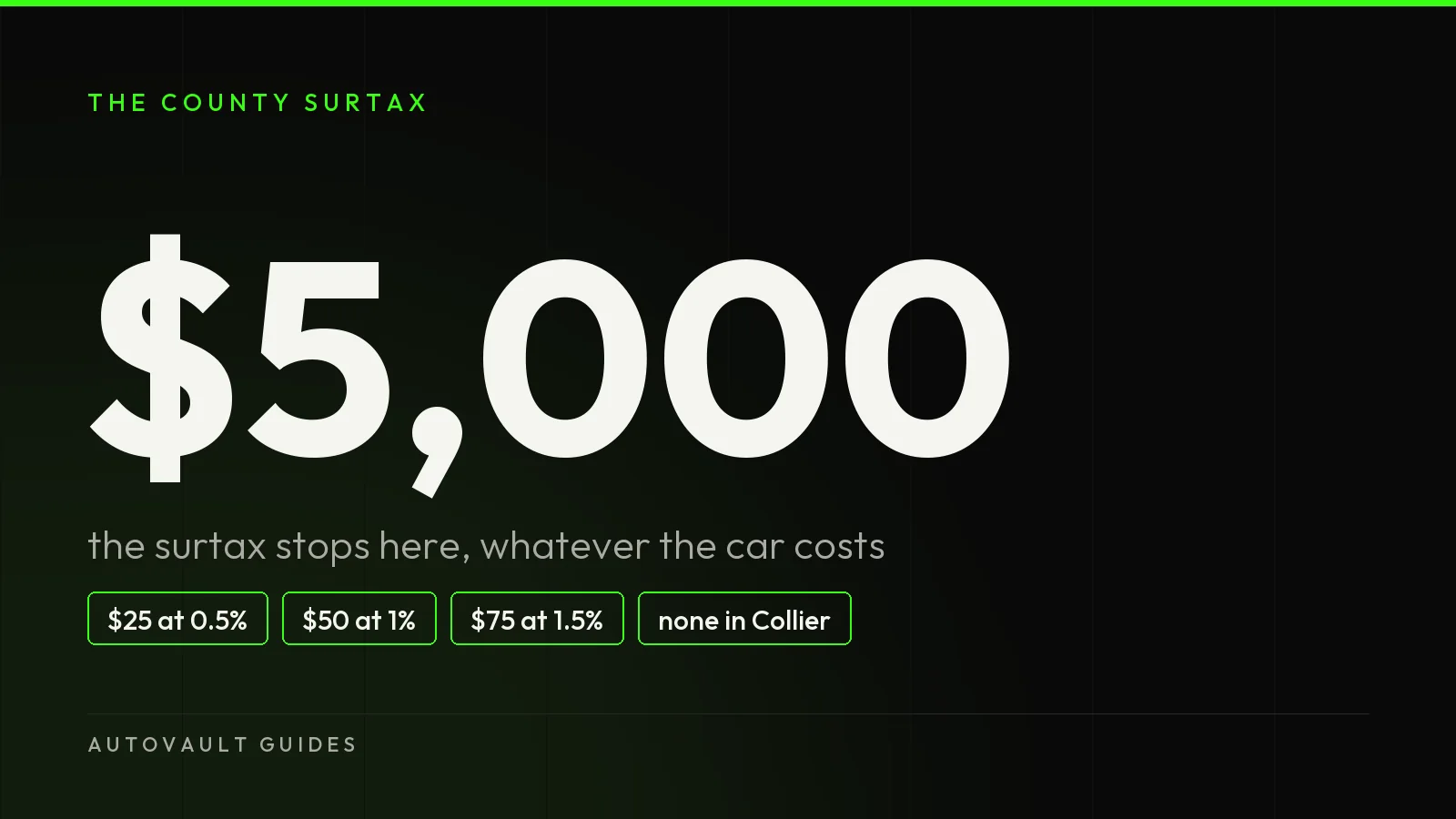
Florida's county discretionary sales surtax applies only to the first $5,000 of a car's taxable price, so on any exotic it is a flat amount: $25 at 0.5 percent, $50 at 1 percent, $75 at 1.5 percent. The rate is set by the county on your registration address, not by the county the dealer sits in. For 2026 that means $50 in Miami-Dade and Broward, $25 in Palm Beach after its January change, and nothing at all in Collier.
What the surtax is and who sets it
Florida charges 6 percent state sales tax on the taxable price of a car. On top of that, most counties add a discretionary sales surtax, a local option tax that each county adopts for a stated purpose, usually for a stated number of years. The Department of Revenue names the types on its own form: a school capital outlay surtax, a local government infrastructure surtax, a small county surtax and a few others. The state collects the surtax with the state tax and lists every county's rate on Form DR-15DSS, reissued each November. The 2026 form, R. 11/25, carries all 67 counties with the effective date of each levy and, where there is one, its expiry date.
The 2026 rates run from nothing at all to 2 percent. Two counties, Citrus and Collier, charge no surtax. Hamilton is the only county at 2 percent. Most of the state sits at 1 percent or 1.5 percent, and seven counties, Palm Beach, Lee, Orange, Martin, St. Johns, Volusia and Hernando, are at 0.5 percent.
On an exotic car the surtax barely registers, and this article explains why. It is one piece of our guide to Florida tax, tag and title for exotic cars, which covers the 6 percent state tax, the title and plate fees and the rules for a buyer from another state in one place.
The $5,000 cap, and why the surtax is a flat $25, $50 or $75
The cap is in Florida Statutes s. 212.054(2)(b)1: the sales amount above $5,000 on any single item of tangible personal property is not subject to the surtax. A car is one item. So the surtax is charged on the first $5,000 of the taxable price and on nothing after that.
That turns a percentage into a fixed sum. At 1 percent, the surtax on $5,000 is $50. At 0.5 percent it is $25. At 1.5 percent it is $75, and at Hamilton's 2 percent it would be $100. Any car with a taxable price above $5,000 pays exactly that figure, whatever the price. A $90,000 Porsche and a $400,000 Rolls-Royce registered at the same address carry the same surtax.
The 6 percent state tax has no such cap. It is charged on the whole taxable amount, so on a $400,000 car it is $24,000 while the county's share is $50. When you compare quotes, the state tax is where the money is. The surtax is small change that people still get wrong, and the next two rules are the reason.
Your county decides, not the dealer's
Florida does not tax a car sale where the showroom stands. Section 212.054(3)(a)2 says the sale of a motor vehicle that has to be registered is deemed to have occurred only in the county shown as the residence address of the purchaser on the registration or title. GT-800030, the Department of Revenue's brochure on motor vehicle sales tax, puts it the same way: surtax is due when the purchaser's residing address on the registration or title is in a county that imposes one.
Our showroom is in North Miami, in Miami-Dade, but that has no bearing on which rate you pay. A buyer with a Fort Lauderdale address pays the Broward rate. A buyer with a Boca Raton address pays the Palm Beach rate. A buyer with a Naples address pays no surtax at all. It works the other way round as well: a Miami-Dade resident who buys from a dealer in Naples still owes the Miami-Dade surtax, because the address on the registration is a Miami-Dade address.
The three counties closest to us each have a page of the tax calculator of their own, with that county's 2026 rate already set: Miami-Dade, Broward and Palm Beach. Miami-Dade and Broward are both 1 percent in 2026. Palm Beach is not, and that is the change worth reading twice.
Palm Beach changed on 1 January 2026
Through 2025 Palm Beach County charged a 1 percent local government infrastructure surtax. That levy was repealed effective 31 December 2025. A new 0.5 percent school capital outlay surtax began on 1 January 2026 and runs to 31 December 2035. Form DR-15DSS for 2026 prints both changes on its second page and shows Palm Beach at a total rate of 0.5 percent.
The practical effect is that the Palm Beach surtax on any car above $5,000 fell from $50 to $25 on New Year's Day. Plenty of online calculators still carry 1 percent and overstate the county tax on a Palm Beach registration by $25. It is not a large sum, but a quote that gets the surtax wrong has usually not been checked against the current form, and that is worth knowing before you trust the rest of it.
The same form shows that most surtaxes carry an expiry date and that rates can change from one calendar year to the next. That is why the calculator on this site states the date its rates were last checked and names the revision of DR-15DSS it uses.
Collier, and the counties with no surtax
Collier County, which takes in Naples and Marco Island, charges no discretionary surtax for 2026. Citrus is the only other county on the form with none. A buyer registering a car at a Naples address pays the 6 percent state tax and nothing on top of it.
Because every other county's surtax stops at $5,000, the Collier saving is small and fixed: $50 against Miami-Dade or Broward, $25 against Palm Beach or Lee, $75 against Monroe or Hillsborough. It is real money and it belongs on the quote, but it is not a reason to choose where you live.
Ten counties, one table
These are the ten counties our buyers most often register in, with the 2026 total surtax rate from Form DR-15DSS and the surtax on a car with a $100,000 taxable price. The last column adds the 6 percent state tax, $6,000 on that price in every county, to show how little the county changes the total.
| County | 2026 surtax rate | Surtax on a $100,000 car | State tax plus surtax |
|---|---|---|---|
| Miami-Dade | 1 percent | $50 | $6,050 |
| Broward | 1 percent | $50 | $6,050 |
| Palm Beach | 0.5 percent | $25 | $6,025 |
| Monroe | 1.5 percent | $75 | $6,075 |
| Collier | none | $0 | $6,000 |
| Lee | 0.5 percent | $25 | $6,025 |
| Orange | 0.5 percent | $25 | $6,025 |
| Hillsborough | 1.5 percent | $75 | $6,075 |
| Pinellas | 1 percent | $50 | $6,050 |
| Duval | 1.5 percent | $75 | $6,075 |
Change the price to $60,000 or $600,000 and the third column does not move. Only the state tax does. The spread between the most expensive county on the list and the cheapest is $75 on any car above $5,000, and the spread between Miami-Dade and its neighbours is $25 at most.
A trade-in changes the base, rarely the surtax
When you trade a car in as part of the same transaction, Florida taxes the price less the trade-in allowance. Section 212.09 says the tax is paid on the sales price of the new article less the credit for the used article taken in trade, and GT-800030 confirms that a registered dealer deducts the allowance from the taxable sales price. The state tax falls with it: a $30,000 trade against a $100,000 car brings the taxable amount to $70,000, so the 6 percent state tax drops from $6,000 to $4,200.
The surtax base falls too, but on an exotic you will not see it. The surtax is charged on the first $5,000 of the taxable amount, and $70,000 is as far above that line as $100,000 was. In a 1 percent county the surtax is $50 before the trade and $50 after it. The trade-in only touches the surtax when it pulls the taxable amount below $5,000, which on the cars we sell does not happen.
Two things to keep straight when you check a worksheet. The trade-in has to be part of the same single transaction for the credit to apply, and the surtax comes off the taxable amount after the trade, not the sticker price. A sheet that shows the surtax on the full price of a car with a trade-in has the order wrong, though on an exotic the answer still comes out at the same flat figure.
The rounding rule
Since 1 July 2021 Florida no longer uses tax brackets. The Department of Revenue's rule is that the tax is computed to the third decimal place and, when that third decimal is greater than 4, rounded up to the next cent. The dealer may apply the rounding to the total tax on the invoice or to each taxable item.
On the surtax of an exotic there is nothing to round. Each 2026 rate applied to $5,000 comes out in whole dollars: $25, $50, $75 or $100. The rule only bites below the cap, where the surtax is a percentage of the full taxable amount. A $4,321 taxable amount in a 1.5 percent county gives $64.815, and the third decimal is 5, so the surtax is $64.82.
The state tax is where rounding can show up on an exotic, and only when the price carries cents. Six percent of a whole dollar amount always lands on an exact cent. Six percent of $98,750.25 is $5,925.015, which rounds up to $5,925.02. One cent, and the software does it.
Run your own numbers
The Florida tax, tag and title calculator takes the price, the trade-in and the county on your registration and returns the state tax, the surtax and the out the door figure, with every rate traced to the document it came from. All 67 counties are in the dropdown at their 2026 rates, Palm Beach included at 0.5 percent.
If you already have a car in mind, the inventory lists every car with its price, and on a purchase here the out the door figure goes in writing before you sign, with the state tax, the surtax and the $695 title, tag and docs line each shown on its own.
Every week someone from Palm Beach tells me their surtax is 1 percent. It was, until this January. On an exotic the whole argument is worth $25, which is why I put the county table on the calculator.
AutoVault
Frequently asked
Where the figures on this page come from
- Florida Statutes s. 212.054, Discretionary sales surtax; limitations, administration, and collection, 2026 Florida Statutes
- Discretionary Sales Surtax Information for Calendar Year 2026, Form DR-15DSS, Florida Department of Revenue, R. 11/25
- Sales and Use Tax on Motor Vehicles, GT-800030, Florida Department of Revenue, R. 08/22
- Florida Statutes s. 212.09, Trade-ins deducted; exception, 2026 Florida Statutes
- Florida Department of Revenue, Sales and Use Tax, the 6 percent rate and the rounding rule in force since 1 July 2021, read 2026-09-20